These are the questions builders, owners and designers ask most about new sewer service connections for infill homes, secondary suites, laneway houses and small multiplexes in Canadian cities. Each answer is short and points to the guide or tool with the detail. City rules and fees are as published when checked in September 2026.
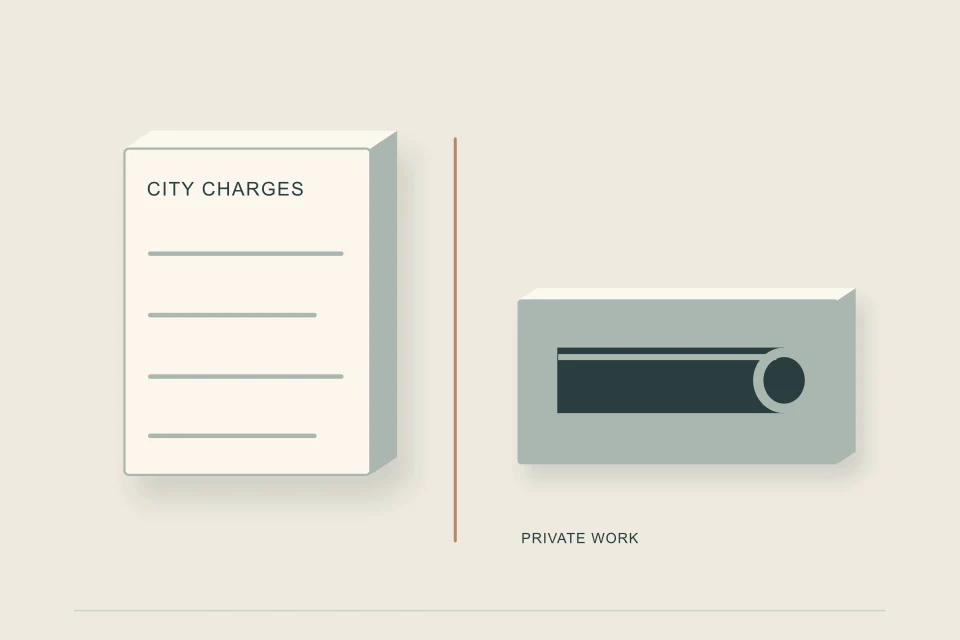
- The city decides who builds the public side, whether an old service can stay, and what it charges.
- The plumbing code decides the minimum size and how load is counted.
- Most delays come from applying late, not from digging.
01 /What does this FAQ cover?
New connections for new buildings and added units: the application, the size, the route, the cost, the inspection and the records. It does not cover replacing a failing lateral under an existing house in Calgary, which sister site NewSewerLine.ca covers, or the craft of laying pipe, which SewerInstall.com covers.
For your own project, start with the Service Connection Planner and the fixture load estimator, or request quotes.
FAQAll questions
What is a new sewer service connection?
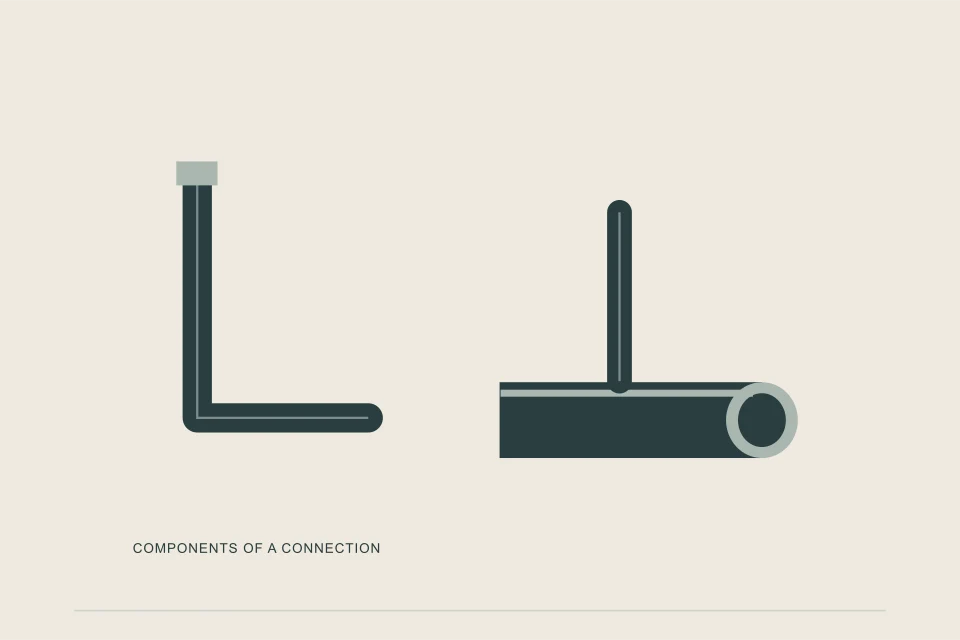
The pipe and the city approval that join a new or changed building to the public sewer: a tap on the main, a public segment to the property line and a private building sewer to the building. See what a sewer tie-in is.
Does a demolish-and-rebuild infill project need a new sewer connection?
Often. Calgary's guidelines call for new services on a rebuild, Halifax replaces services 30 years or older, and Toronto and Vancouver accept reuse only for PVC in good condition on video. See the reuse guide.
Who is allowed to connect a new service to the city main?
Only the party the city authorizes: city crews or contractors, or an approved, authorized or licensed contractor, depending on the city.
What permits does a new sewer service need?
Usually a connection approval, a plumbing or site servicing permit for the private side, and a right-of-way permit for street work. See the permit guide.
How early should the connection application go in?
During design, before the foundation depth is fixed. Several cities want it before or alongside the building permit.
What size sewer service does a fourplex need?
By the plumbing code table, a typical fourplex of about 68 fixture units fits a 4-inch building sewer at 1 in 100, which carries 180. City minimums can require larger. See sizing.
What is the smallest sewer allowed to connect to a public sewer?
NPS 4, downstream of the main cleanout, under National Plumbing Code Article 2.4.9.4.
Can a garden suite or laneway house use the main house sewer?
Usually, because the code lets an ancillary building on the same lot share the service. Some cities also allow a separate connection. See the laneway and garden suite guide.
When does each unit need its own sewer service?
When units are on separate lots or titles in every city checked, and for side-by-side units in Edmonton even on one title.
Does an infill multiplex need a storm sewer connection?
Often: Saskatoon requires one at three or more units, EPCOR a private storm system at three or more, and Calgary's Fast Track for R-CG requires storm service.
How much does the city charge for a new sewer connection?
It varies widely: Toronto $14,718.78 for a new residential sanitary connection in 2026, Vancouver $21,656 flat plus $2,200 for a house-scale connection, and review, inspection or tap fees where your contractor builds to the main.
What does the private side of a new service cost?
Typically $600 to $1,000 per metre shallow and $1,000 to $2,000 per metre deep or under hard surfaces, plus cleanouts, permits and restoration, as CAD 2026 planning estimates. See the cost guide.
How long does a new sewer connection take from application?
Toronto targets 12 to 14 weeks plus technical review; Vancouver schedules house-scale connections within 4 to 6 months after the sump inspection; EPCOR builds in 3 to 5 days once scheduled.
Will my city check whether the sewer has capacity for more units?
Some do: Saskatoon pre-reviews three or more units in listed neighbourhoods, Halifax Water can require a hydraulic analysis on a change of use, and Winnipeg asks detached-suite applicants to request a capacity assessment.
What happens to the old service when a new one is installed?
It is abandoned to the city's standard, often with a fee or deposit, such as Toronto's $1,816.50 sanitary disconnection or Winnipeg's $5,380 deposit per service.
Is a camera inspection needed for a new connection?
Not by the plumbing code for new pipe, but several cities require one to reuse an existing lateral, and a recorded run of the new service is the best record of how it was left.
Who inspects a new sewer service before backfill?
The city inspects the public connection; the plumbing inspector inspects the private building sewer. See the inspection guide.
What if the new basement is lower than the sewer main allows?
Fixtures that cannot drain by gravity go to a sealed, vented sump with a pump or ejector. See the pumped services guide.
Does adding a basement suite change the backwater valve?
Usually. A normally open backwater valve in a building drain may serve only one dwelling unit, so protection is arranged per unit or per branch. See secondary suite plumbing.
Are water and sewer applied for together?
In most cities, yes, and they usually share a trench, but they are sized, laid at different depths and inspected separately. See the water and sewer guide.
Can roof downspouts or foundation drains go into the new sanitary service?
Not in most cities for new buildings. See sanitary, storm and combined sewers.
Which code sets the sizing rules in Ontario?
The Ontario Building Code's plumbing part, rather than the National Plumbing Code directly. Alberta has had the NPC 2020 in force since April 1, 2023.
Is HAUSE a contractor that installs sewer connections?
No. HAUSE is an independent information and quote-request network. It explains the process and can pass your request to contractors; it does not do the work.