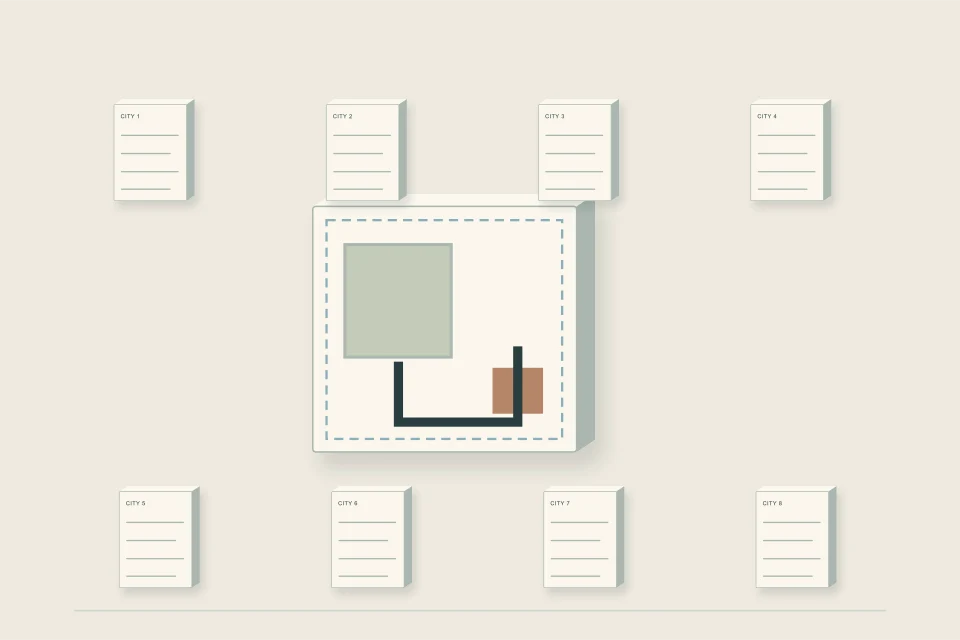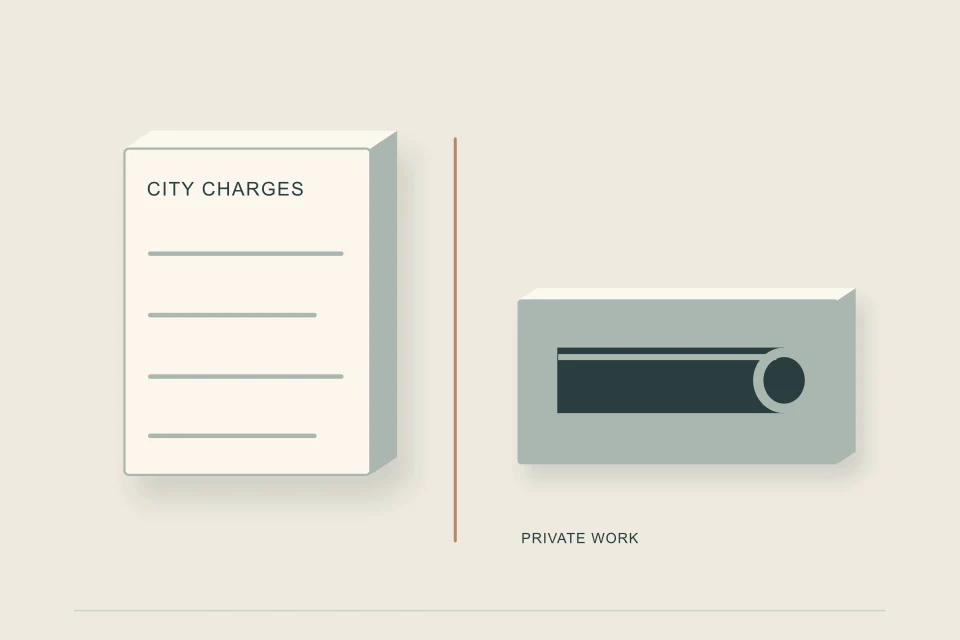
A new sewer connection has two prices. The city side is set by the municipality: in 2026 Toronto charges $14,718.78 for a new residential sanitary connection and Vancouver a flat $21,656 plus a $2,200 application fee, while Calgary, Saskatoon and Halifax charge review, inspection or tap fees and your contractor builds more. The private side typically runs $600 to $2,000 per metre plus fixed items.
- Split every budget at the property line: city charges on one side, your contractor's work on the other.
- Where the city builds the public side, as in Toronto and Vancouver, its published charge is often the biggest single number in the project.
- Where your contractor builds to the main, as in Calgary, Saskatoon and Halifax, the city charges review, inspection and tap fees and the road work lands in your quote.
- Private-side work typically quotes $600 to $1,000 per metre shallow and $1,000 to $2,000 per metre deep or under hard surfaces, plus fixed items.
- Budget for the old services too: disconnection fees or deposits, a camera run, and sometimes a separate storm connection.
01 /How much does a new sewer connection cost?
There is no single national price, because two different bills are involved. The city side runs from the main in the street to the property line. Depending on the city, it is either built by city crews or city contractors and charged to you as a published fee or at cost, or built by your own licensed or approved contractor and charged to you through their quote plus city review, inspection and tapping fees. The private side runs from the property line to the building and is always your contractor's work under a plumbing permit.
02 /What do cities charge for the public side?
These are the connection-related figures each city or utility publishes, as checked in September 2026. Where a city publishes no connection fee, it is because your contractor builds the public side and the cost sits in their quote.
| City | Who builds the public side | Published figures |
|---|---|---|
| Toronto | City contractors | New residential sanitary connection $14,718.78; storm $14,718.78; 19 mm water and meter $5,884.44; 25 mm $6,818.29 (2026) |
| Vancouver | City crews | Sewer application $2,200; sewer connection flat $21,656 for a house with or without a laneway house, or a duplex; multiplexes at cost; 25 mm water $11,520 (house or duplex) |
| Calgary | City-approved indemnified contractor | Site servicing plan review $1,533 where one is required; storm redevelopment levy $84 per metre of frontage in the levy area |
| Edmonton | EPCOR crews or authorized contractors, at the customer's cost | By quote, valid 30 days; wastewater record search $175 per titled lot |
| Saskatoon | Licensed water and sewer contractor | Inspection $185 per hour, 2-hour minimum per connection; City tap up to 50 mm $415 |
| Halifax | Applicant's contractor; Halifax Water taps | Tap $375 (19 to 50 mm); inspection $175 per visit; Regional Development Charges per net new unit |
| Winnipeg | City or licensed contractor | New or reused sewer connection application $241; water $241 |
| Ottawa | Not confirmed | Fees not confirmed; the City's 2017 coach house guide estimated servicing at $10,000 to upwards of $30,000 |
Two cities add charges on top of the connection itself. Halifax Water's Regional Development Charge for a multi-unit dwelling is $4,115.04 for wastewater and $1,290.77 for water per unit, applied to the net increase in units, and the charges were frozen when checked. Calgary's storm redevelopment levy applies inside a defined area. Edmonton's Sanitary Sewer Trunk Charge has been paused since May 13, 2024.
03 /What does the private side cost?
The private side is priced like any new sewer trench, and the network's published ranges apply. Excavation and restoration, not pipe, drive the number.
| Item | Range | What moves it |
|---|---|---|
| Trench and pipe, shallow, soft landscaping | $600–$1,000 per metre | Length, soil, access |
| Trench and pipe, deep (about 2.5 m or more) or under hard surfaces | $1,000–$2,000 per metre | Shoring, concrete or asphalt, spoil handling |
| Mobilisation and utility locates | $500–$2,000 | Equipment and site setup |
| Cleanout | $600–$2,500 | Interior or exterior, depth |
| Backwater valve in new construction, where required | $800–$2,500 | One per dwelling unit in some layouts |
| Permits and inspections | $150–$2,000+ | Plumbing, right-of-way, connection permits |
| Restoration | $500–$15,000+ | Seed and topsoil at the low end; concrete and landscaping at the high end |
| Camera run of the existing service | $250–$600 | Needed before any reuse request |
A separate storm service is another trench or a second pipe in the same trench, priced by the same per-metre logic. A water service usually shares the trench; for water-service materials and lead replacement programs, see sister site WaterMainReplacement.ca. Where the new basement is deeper than the main allows by gravity, a pumped service adds the cost of a sump and pump; the pumped services guide explains when that happens.
04 /What does a whole connection add up to? Three worked examples
These combine published city figures with the private-side ranges for a 10 m run from the property line to the building. They are arithmetic on published numbers, not quotes.
| Project | City side | Private side, 10 m deep trench | Not included |
|---|---|---|---|
| Toronto fourplex, new sanitary, storm and 25 mm water | $14,718.78 + $14,718.78 + $6,818.29 = $36,255.85 | $10,000–$20,000 trench plus $1,750–$21,500 fixed items | Disconnection of old services ($1,816.50 sanitary, $1,739.74 water), technical review, tax |
| Vancouver house with a laneway house, 25 mm water | $2,200 + $21,656 + $11,520 = $35,376 | Same private-side ranges | At-cost billing if the install would exceed 1.15 times the flat fee |
| Calgary fourplex on a 15 m frontage in the storm levy area | $1,533 review + $84 × 15 m = $2,793 in city fees | Private side as above, plus the contractor's public-side work to the main | Public-side excavation and road restoration in the contractor's price |
The pattern is the useful part. In Toronto and Vancouver the city's half dominates and is known in advance. In Calgary, Saskatoon and Halifax the city's fees are modest but your contractor digs to the main, often across a sidewalk and into the road, so their quote carries the risk. Compare quotes on the same scope: which side each covers, who restores the road, and whether storm and water are included. The Service Connection Planner produces the same split for your own length and city.
05 /What costs are easy to miss?
- The old services. Toronto charges $1,816.50 to disconnect a sanitary connection; Winnipeg holds $5,380 deposits for each sewer and water service abandonment; Saskatoon holds $3,000 for a residential cut-off on demolition; Calgary requires a disconnection deposit before servicing plan approval.
- Reuse inspections. Toronto charges $735.81 for a sewer reuse inspection, and Vancouver charges 20 percent of the connection fee to reuse a connection that was previously paid for.
- A storm connection. Saskatoon requires one for three or more units, Edmonton a private storm system for three or more, and Toronto prices a new storm connection the same as sanitary.
- Engineering. Multiplex applications in Vancouver, Edmonton and Calgary need engineer-prepared or stamped servicing drawings.
- Fire flow. Saskatoon's pre-review and Edmonton's fire protection assessment can reveal hydrant or main upgrades; EPCOR's Infill Fire Protection Program can share those costs for eligible projects.
- Timing. A long city queue costs carrying interest; Vancouver schedules house-scale connections within 4 to 6 months after the sump inspection, and Toronto targets 12 to 14 weeks from application.
06 /Are there grants or cost-share programs?
Some, and they are time-limited. As checked in September 2026, Halifax's second unit incentive offered up to $10,000 toward water and sewer connection costs, with applications due by October 11, 2026. Calgary's Established Area Linear Levy pilot reimbursed first-in water and sanitary pipe upgrades up to $2,100 per linear metre, but submissions closed on September 1, 2026. Edmonton's Infill Infrastructure Fund, for projects of ten or more units, had allocated its original funding by December 2025 with only a non-market stream open. Check the city page for your city before you count on any of them.
Before you ask for prices, count the load with the fixture load estimator, check whether the old service can stay, and then request quotes that state which side of the property line each price covers.
FAQQuestions people ask
How much does it cost to tie into city sewer in Canada?
It depends on who builds the public side. Toronto's 2026 fee for a new residential sanitary connection is $14,718.78 and Vancouver's flat house fee is $21,656 plus $2,200; where your contractor builds to the main, the public side is in their quote.
What does a sewer tie-in cost for a laneway house?
In Vancouver the connection fee for a single house with or without a laneway house is the same flat $21,656, because the lot shares one connection. Elsewhere, a branch from the main house sewer is priced like private-side trenching at $600 to $2,000 per metre.
Is the city connection fee included in a contractor quote?
Not usually where the city builds the public side, as in Toronto and Vancouver; you pay the city directly. Where your contractor builds to the main, ask whether the quote includes road restoration and the city's inspection and tap fees.
Do multiplexes pay more for sewer connections than houses?
Often. Vancouver bills multiplex connections at cost instead of the flat house fee, multi-unit sites often need engineered servicing drawings and a storm connection, and Halifax levies development charges per net new unit.
How much does it cost to disconnect an old sewer service?
Toronto charges $1,816.50 for a sanitary disconnection in 2026; Winnipeg and Saskatoon hold refundable deposits of $5,380 and $3,000. Other cities fold abandonment into their permits.
Are there grants for new sewer connections for suites?
Halifax's second unit incentive offered up to $10,000 toward connection costs, with applications due October 11, 2026. Most other programs checked were closed, paused or aimed at larger projects.
NETWORKGo deeper across the HAUSE Sewer network
New sewer line cost: new connections, infill services and septic-to-sewer
New sewer line cost in Canada (2026): CAD planning ranges for new house connections, infill services and septic-to-sewer conversions, plus fees to confirm.
SewerJetting.caHydro jetting cost in Canada: typical quoted ranges and what drives them
Hydro jetting cost in Canada for 2026: typical quoted ranges for main lines, kitchen lines, camera add-ons, roots, after-hours and commercial work.
SewerInspector.caSewer camera inspection cost: 2026 planning ranges for Canada
Sewer inspection cost in Canada for 2026: planning ranges for a camera scope, locating, toilet access, clean-and-scope and multi-unit work, and price drivers.