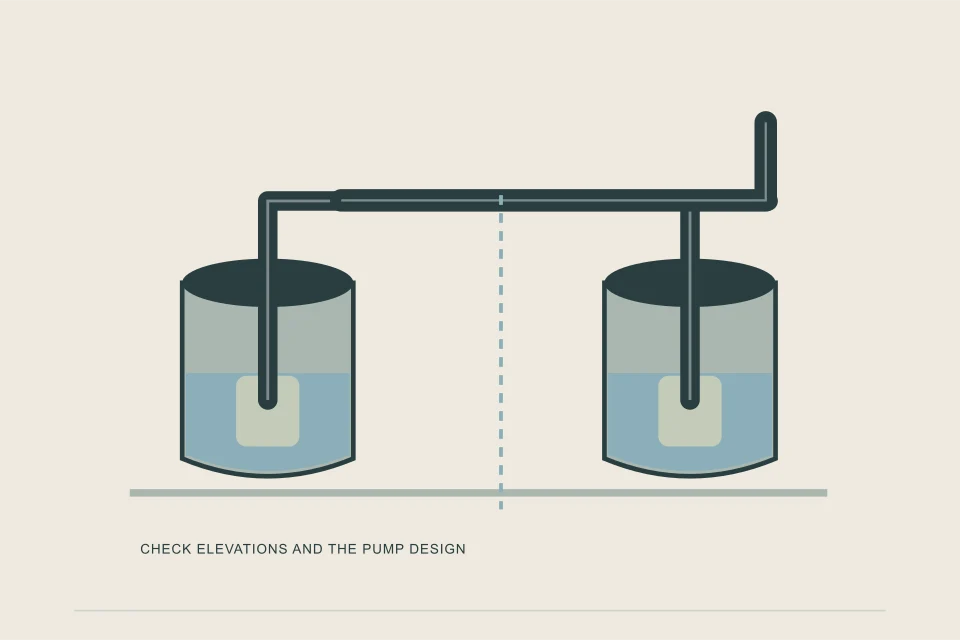
A building needs pumping when some of its fixtures sit too low to drain to the tie-in by gravity. The plumbing code then requires those fixtures to drain to a sealed, vented sump with a pump or ejector that lifts the sewage into the building drain or sewer, through a discharge pipe fitted with a union, a backwater valve and a shut-off valve. A duplex ejector uses two pumps so one can fail without flooding the basement.
- Gravity is the default; pumping is for fixtures below the level the tie-in allows.
- NPC 2.4.6.3 governs: a watertight, airtight, vented sump for sewage, and a pump or ejector that lifts into the building drain or sewer.
- Every pumped sump discharge needs a union, a backwater valve and a shut-off valve in that order.
- A duplex system has two pumps that alternate and back each other up; the code checked does not require it, but multi-unit designs often choose it.
- A pumped discharge counts toward the building sewer's load: 31.7 fixture units for each litre per second.
01 /Why would a new building need a pumped sewer service?
Because the lowest fixtures sit below the level the tie-in allows. A gravity sewer must fall steadily from the building drain to the main: at least 1 in 100 for a 4-inch pipe and 1 in 50 for pipe of NPS 3 or less. On infill lots three things squeeze that fall. The main may be shallow. The building may be far from it, as a laneway house at the back of a lot is. And missing-middle projects push basements deeper to fit more floor area, sometimes with basement suites whose bathrooms sit well below the old house's basement floor.
Article 2.4.6.3 of the National Plumbing Code is direct about the result: piping that is too low to drain into a building sewer by gravity shall be drained to a sump or receiving tank. The rest of the article describes that sump and the equipment that empties it.
02 /How do you know whether gravity will work?
Work backwards from the main. Take the invert of the tie-in from city records or by exposing the pipe, add the fall the building sewer needs over its length, and you have the lowest point at which the building drain can leave the foundation. Any fixture whose trap is lower than that, allowing for the drain inside, needs a pump.
- Tie-in invert
Say the main connection sits 2.4 m below grade at the property line, the cover EPCOR sets for sanitary services there.
- Run and slope
Twelve metres of 4-inch building sewer at 1 in 100 needs 120 mm of fall.
- Building drain level
The drain can leave the foundation no lower than about 2.28 m below grade, before the pipe diameter and any drain run inside the building are counted.
- Compare
A basement slab at 2.5 m with fixtures above it will not drain by gravity; those fixtures need a sump or the design changes.
The numbers above are illustrative arithmetic, not a design. The inputs that matter are yours: the actual invert, the actual route and the actual floor levels. EPCOR's standard sewer service depth of 3.0 m and Winnipeg's 2.3 to 2.75 m branch burial range show how much these vary between cities.
03 /What does the plumbing code require for a pumped sump?
Article 2.4.6.3 of the National Plumbing Code of Canada 2020 sets the rules. In plain terms:
| Sentence | Requirement |
|---|---|
| (1) | Piping too low to drain to the building sewer by gravity drains to a sump or receiving tank. |
| (2) | A sump or tank receiving sewage is water- and air-tight and vented. |
| (3) | A sump receiving subsurface water from a subsoil drainage pipe has a water- and air-tight cover. |
| (4) | A pump or ejector that can lift the contents into the building drain or sewer is installed. |
| (5) | If the equipment is not automatic, the sump holds at least a 24-hour accumulation. |
| (6) | Where there is a building trap, the discharge connects downstream of it. |
| (7) | Every pumped sump discharge pipe has a union, a backwater valve and a shut-off valve, in that order in the direction of discharge. |
| (8) | Discharge piping is sized for optimum flow velocities at the pump's design conditions. |
Ontario applies its own Building Code and Vancouver its own Building By-law; the requirements are of the same kind, but confirm the governing text with your permit office.
04 /What is a duplex ejector pump system?
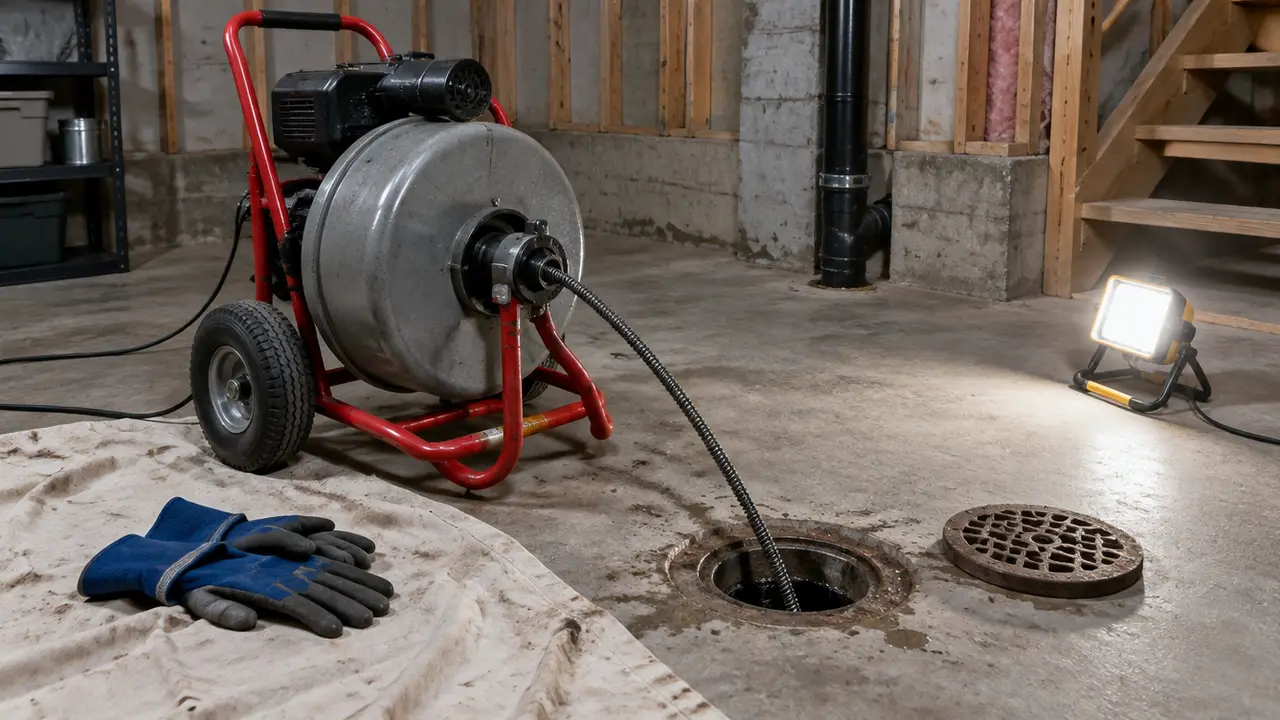
A sump fitted with two pumps instead of one. The controls alternate which pump runs so both wear evenly, and bring the second pump on if the first fails or cannot keep up, usually with an alarm. In plumbing equipment, "duplex" means two pumps, not a duplex house, although the two often meet on missing-middle projects.
The National Plumbing Code articles reviewed here do not require a second pump; a duplex system is a choice the designer makes, or one a local authority or engineer may specify. On a multiplex where several dwelling units drain to one sump, the argument for redundancy is strong, because a single pump failure affects every household that relies on it. Ask your designer and permit office which they expect.
05 /How does pumping change the building sewer?
The pumped flow adds load. Sentence 2.4.10.3.(1) treats a fixture that produces a continuous flow, such as a pump, as 31.7 fixture units for each litre per second, when it drains to a sanitary system. A pump delivering 1 L/s adds 31.7 fixture units to the building sewer downstream of the discharge, which the fixture load estimator can include through its pumped-flow input.
The discharge pipe from the pump also has its own sizing rule: Sentence 2.4.6.3.(8) asks for discharge piping sized for optimum flow velocities at the pump's design conditions, which means the pump maker's data and the designer's calculation, not a fixture-unit table. Where there is a building trap, the discharge joins the building drain downstream of it.
Only the fixtures that cannot drain by gravity should go to the sump. Upper floors, and any basement fixtures that do clear the tie-in, still drain by gravity, which keeps the pumped load and the consequences of a pump failure small. Where the low fixtures are below the adjoining street, backflow protection is needed too; the code's backwater valve rules for multiple dwelling units are covered in the secondary suite plumbing guide.
06 /What does a pumped connection cost?
The network's planning range for a residential grinder pump station, the nearest published comparison, is $5,000 to $12,000 installed, including the dedicated circuit and alarm. This site publishes no separate range for sewage ejector sumps, so get them quoted and itemised; a duplex system adds a second pump and its controls to whatever a single pump costs. Ongoing costs are electricity, periodic service and eventual pump replacement.
Before accepting a pumped design, ask whether a deeper tie-in is possible, whether a larger pipe at a flatter permitted slope would reach, or whether raising the lowest fixtures is simpler. Ottawa's coach house guide notes that a sewage pump may be needed for a coach house, which is a reminder that suites at the back of a lot are the most common case. Use the Service Connection Planner to check your city's route and request quotes with the invert and floor levels in hand.
FAQQuestions people ask
When does a house need a sewage ejector pump?
When fixtures sit too low to drain by gravity to the building sewer. The plumbing code then requires them to drain to a sealed, vented sump with a pump or ejector that lifts the sewage into the building drain or sewer.
What is a duplex sewer ejector system?
A sump with two pumps that alternate and back each other up, usually with an alarm. It keeps working if one pump fails, which matters where several units rely on one sump.
Does the plumbing code require a backwater valve on an ejector discharge?
Yes. NPC Sentence 2.4.6.3.(7) requires a union, a backwater valve and a shut-off valve on every pumped sump discharge pipe, in that order in the direction of discharge.
Do multiplexes need duplex pumps?
The NPC articles reviewed do not require two pumps. Designers often choose duplex systems where several units drain to one sump; ask your designer and permit office.
How many fixture units does a sewage pump add?
A pump discharging to a sanitary drain counts as 31.7 fixture units for each litre per second of flow, under NPC Sentence 2.4.10.3.(1).
NETWORKGo deeper across the HAUSE Sewer network
Backwater valve installation: whether you need one, where it goes and how it is done
Should you install a backwater valve? When one is required, how it differs from a sump pump, how installation works, where it goes, costs and subsidies.
SewerQuotes.comNew sewer line cost: new connections, infill services and septic-to-sewer
New sewer line cost in Canada (2026): CAD planning ranges for new house connections, infill services and septic-to-sewer conversions, plus fees to confirm.
PipeCleaning.caWashing machine drain pipe: where it is, what size it is and how to clean it
Washing machine drain pipe guide: where the standpipe or laundry tub drain is, what size it should be, why it overflows, and how to clean out lint and scum.