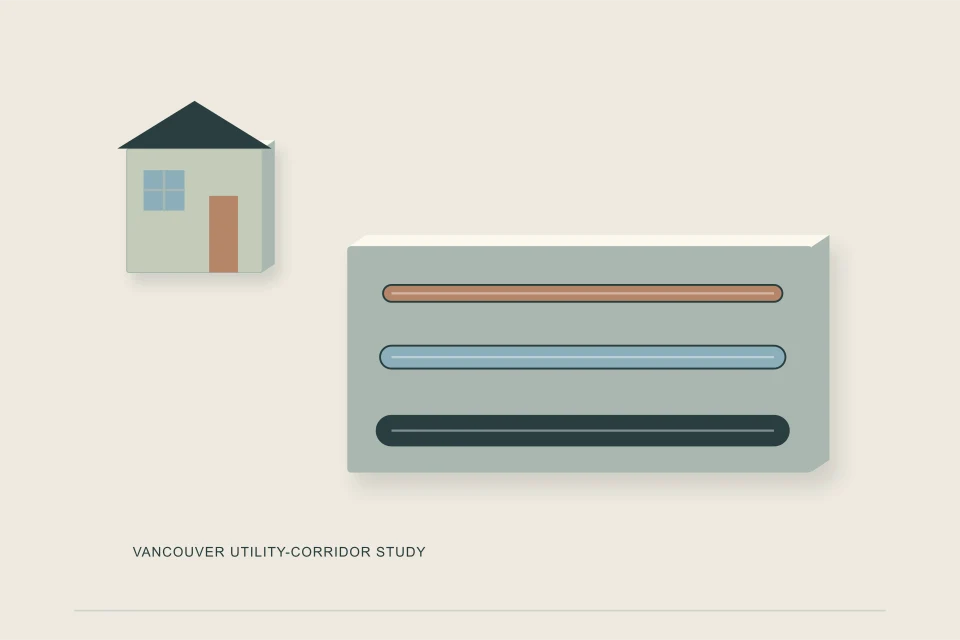
In Vancouver, City crews install new sewer and water service connections. A house, duplex or laneway house needs one combined residential sewer and water connection permit, with a recent legal survey and a BC One Call gas sketch. Multiplexes and larger buildings need separate commercial sewer and water permits prepared by a BC professional engineer. Fees are set in the sewer and waterworks by-laws.
- City crews, not private contractors, install the public connections, and the City auto-schedules the work within 4 to 6 months of the sump inspection and capping, as checked September 2026.
- A house, duplex or laneway house uses one combined residential sewer and water permit; multiplexes use commercial permits engineered by a BC P.Eng.
- Under By-law 8093, each parcel gets its own sewer connection and new work has separate sanitary and storm connections.
- By-law 8093 listed a flat $21,656 sewer connection fee for a single house with or without a laneway house, or a duplex, plus a $2,200 application fee.
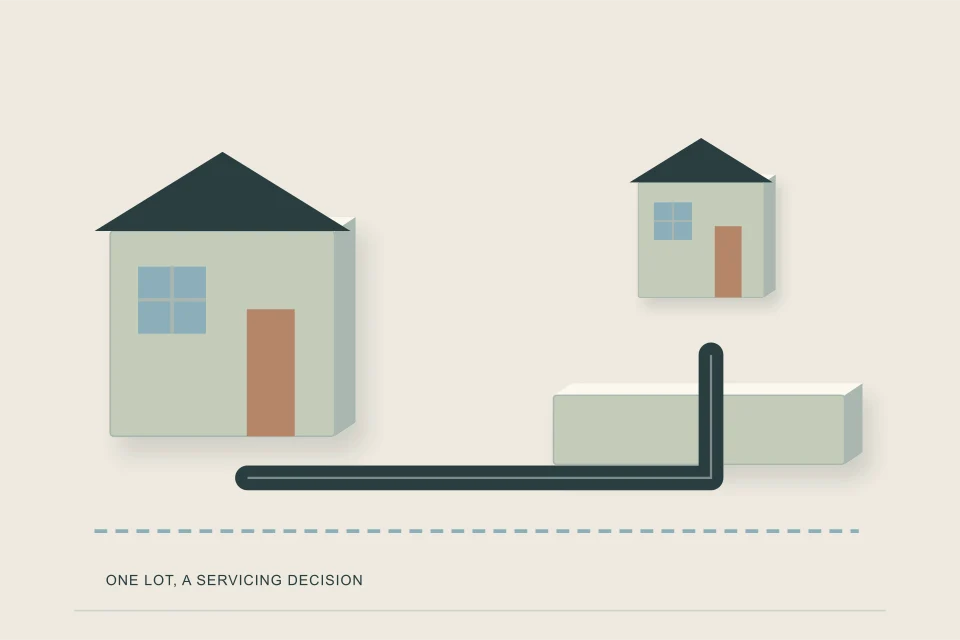
- Water service goes one service and one meter per legal lot; a laneway house does not get its own water service.
01 /Who installs a new sewer connection in Vancouver?
City of Vancouver crews install the public sewer and water connections; the owner's plumber and contractor build the private side to the property line connection point. As checked September 2026, the City's sewer and water connection permits page says that once the sump inspection and capping of the old services are done, the connection is automatically scheduled within 4 to 6 months, and it asks applicants to contact the City if nothing has been scheduled within 5 months.
That lead time is the biggest planning fact in Vancouver. Because the City's crew does the tie-in, a builder cannot buy a faster connection by hiring a different contractor, so the permit goes in early. HAUSE is an information and quote-request network, not a contractor; private-side quotes are the part it can help gather.
02 /Which permit does a Vancouver house, duplex, laneway house or multiplex need?
A house, duplex or laneway house needs one combined residential sewer and water connection permit, placed ahead of the development and building permits, while a multiplex or a building of more than three units needs separate commercial sewer and commercial water permits prepared by a BC professional engineer. The City's page, as checked September 2026, lists a legal survey no older than six months and a BC One Call gas sketch for the residential permit.
| Project | Permit | What goes with it |
|---|---|---|
| House, with or without a secondary suite | Combined residential sewer and water permit | Legal survey no older than 6 months; BC One Call gas sketch |
| Laneway house on a house lot | Same combined residential permit | No separate water service for the laneway house; one service and meter per legal lot |
| Duplex | Combined residential permit | Same survey and gas sketch; no separate fire service |
| Multiplex (3 to 8 units) or more than 3 units | Commercial sewer permit and commercial water permit | BC P.Eng design, peak demand, Certification Form for Public Sewer Connections; FUS fire flow only if rezoned |
The City's multiplex page, as checked September 2026, describes multiplexes as 3 to 8 units and notes rainwater management requirements that apply from July 1, 2025. The multiplex sewer servicing guide explains how a designer sizes a shared building sewer for that range.
On the plumbing side, the City's own Building By-law and its permit office govern in Vancouver; confirm the applicable plumbing provisions, including backwater valve arrangements for suites, with the City rather than assuming another province's code edition.
03 /What does Vancouver charge for new sewer and water connections?
Vancouver publishes its connection fees in by-law schedules: By-law 8093 set a $2,200 application fee and a flat $21,656 sewer connection fee for a single house with or without a laneway house, or a duplex, as checked September 2026. Other building types are charged at cost, and the flat-rate job also moves to cost if actual cost exceeds 1.15 times the flat fee.
| Item | What the source says | As checked |
|---|---|---|
| Sewer application fee | $2,200 (By-law 8093) | September 2026 |
| Sewer connection, single house with or without laneway, or duplex | $21,656 flat; at cost if cost exceeds 1.15 times | September 2026 |
| Sewer depth surcharge | Plus 10% per foot beyond 5 ft | September 2026 |
| Sewer inspection | $586 | September 2026 |
| Water, flat rate | 20 mm $11,127; 25 mm $11,520 (By-law 4848) | September 2026 |
| Water, other connections | 25 mm $14,059; 50 mm $17,644; 100 mm $25,506 | September 2026 |
Read the depth surcharge line against the by-law schedule itself to confirm which dimension it measures. Private-side work is extra: 2026 network planning ranges run $600 to $1,000 per metre for shallow trench and pipe and $1,000 to $2,000 per metre deep or under hard surfaces, as the new sewer connection cost page explains.
04 /How are laneway houses serviced in Vancouver?
A laneway house shares the lot's water service and meter and goes on the same combined residential sewer and water permit as the main house. The City's water connection permitting procedure, as checked September 2026, says one service and one meter per legal lot and no separate water service for infill developments, and By-law 8093 gives each parcel its own sewer connection.
The water service has to be sized for the whole lot, domestic demand plus fire, so check the existing service against that demand; By-law 4848 also limits water reuse to services of 50 mm or less and no more than 24 years old. The laneway and garden suite guide walks through the drainage layout.
05 /Can a Vancouver redevelopment reuse its existing services?
Sometimes, under strict tests. By-law 8093 section 2.9 allows sewer reuse only if the connection is adequately sized, not combined, PVC and in good condition, proven by PACP or LACP coded video; a reuse fee of 20 percent applies where a connection fee was previously paid. By-law 4848 limits water reuse to services of 50 mm or less that are no more than 24 years old, as checked September 2026.
Section 2.4 of By-law 8093 sets August 21, 1984 as the date after which separate sanitary and storm connections are required, and the reuse test excludes combined services, so an older single combined service does not carry over into a new build.
06 /What should you ask the City of Vancouver before you apply?
- Does my project fit the residential permit, or does unit count or rezoning push it to commercial permits?
- Is my legal survey recent enough, and does the BC One Call gas sketch cover the whole frontage?
- Will my existing sewer pass the section 2.9 reuse tests, and what video standard do you want?
- What water size will the City require for domestic plus fire demand?
- When will the sump inspection and capping happen, so the 4 to 6 month clock can start?
Use the service connection planner to line these up against your build schedule, and request quotes for the private side.
FAQQuestions people ask
Who connects a new house to the Vancouver sewer main?
City of Vancouver crews install the public connection. The owner applies for the permit and has the private side built; the City then schedules its crew.
How long does a Vancouver sewer and water connection take after the permit?
As checked September 2026, the City auto-schedules the work within 4 to 6 months after the sump inspection and capping of old services, and asks you to contact it if nothing is scheduled within 5 months.
Does a Vancouver laneway house get its own water service connection?
No. The City allows one water service and one meter per legal lot and no separate water service for infill such as a laneway house. It goes on the same combined permit as the house.
What is the flat Vancouver sewer connection fee for a house with a laneway house?
By-law 8093 listed $21,656 for a single house with or without a laneway house, or a duplex, plus a $2,200 application fee, as checked September 2026. Confirm the current schedule.
Who designs the sewer connection for a Vancouver multiplex?
A BC professional engineer prepares the commercial sewer and commercial water permit submissions, including peak demand and the Certification Form for Public Sewer Connections.
Can I reuse an old sewer service connection in Vancouver?
Only if it is adequately sized, not combined, PVC and in good condition on PACP or LACP coded video, under By-law 8093 section 2.9. A reuse fee of 20 percent applies if a fee was previously paid.